Long before truth and reconciliation became a national conversation in Canada, an unassuming man named Craig Macdonald was already living out an inspiring story of reconciliation in action.
In 1966, Craig Macdonald began travelling with and interviewing Indigenous trappers and travellers to document and preserve traditional Anishinaabemowin place names, original shorelines, elevations, and seasonal travel routes—work that would become the Traditional Map of Temagami. The project spanned 30 years and concluded in 1996, when the map was published. The map shows Temagami’s lakes, portage trails and winter routes as they were when the Teme-Augama Anishnabai were the only inhabitants of the area.
The back story behind Craig’s historically significant project was captured in a biography written by best-selling author James Raffan in a book entitled Echo Maker. The book was officially launched on Bear Island on October 22, 2025 and the following day October 23, 2025 at the Bunny Miller Theatre, located at the Temagami Municipal office. Approximately 50 people attended the launch in Temagami and were treated to a rare opportunity to meet the author James Raffan and his subject Craig Macdonald.
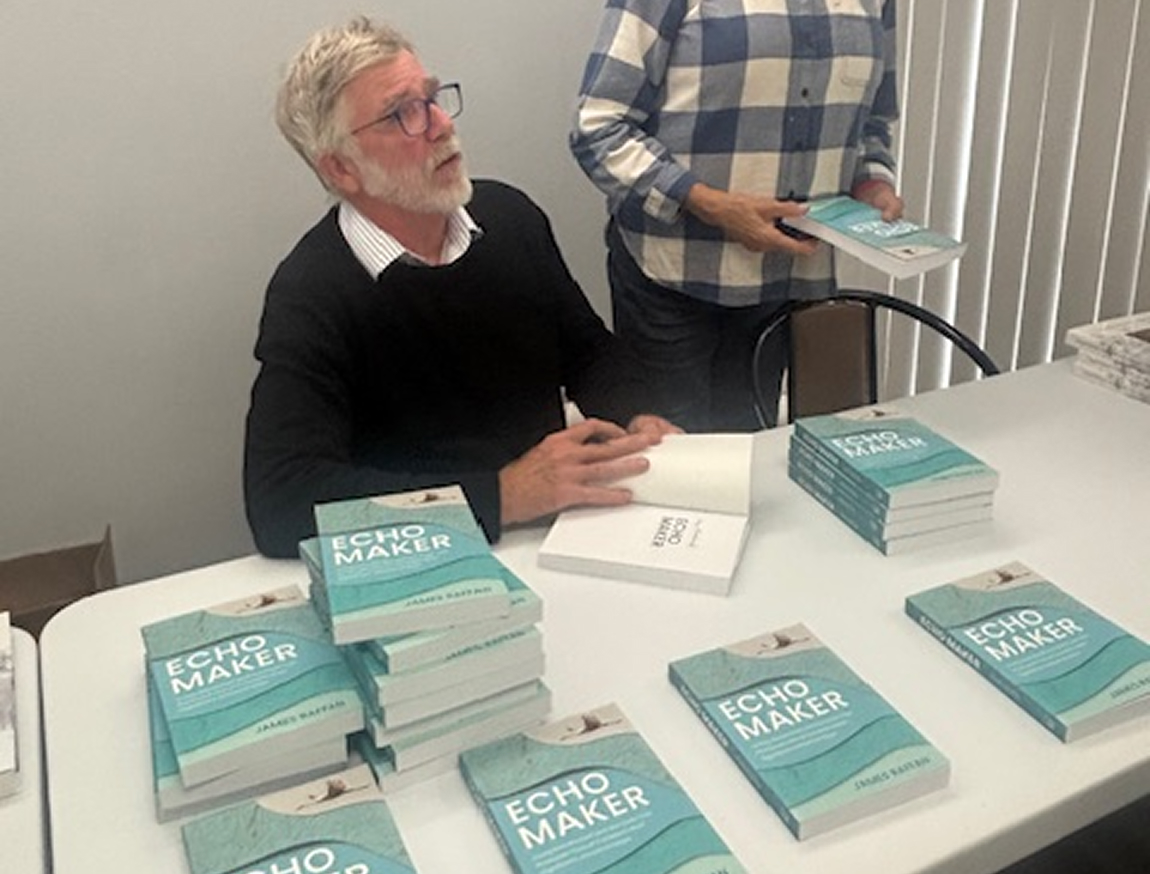
The book launch started with a discussion between Victoria Grant and the author James Raffan, followed by a question-and-answer period with Craig Macdonald. The event ended with the participants having their books signed by the author.
In 2020, the Temagami Community Foundation was approached by Victoria and Richard Grant to sponsor the project, a book about Craig Macdonald and his remarkable map of the Temagami area. The book was paid for through funds the Grants generously donated to the Foundation. The Foundation in turn owns the manuscript and the royalties from the book which will be placed in a reconciliation fund to benefit the Teme-Augama Anishnabai and n’Daki Menan.
The Grants have known Craig and of his map project since the 1970s. Victoria Grant recalled an event in 2008 at Bear Island where Craig gave a presentation to the community in which he shared the story behind the map’s genesis. The presentation was followed by a 5-minute standing ovation from the community. It was at that event that the Grants asked Craig if he would ever consider writing a book about the map. Craig said he didn’t have it in him but if someone wanted to write it, he certainly would support it.
The Grants began a quest to find an author who could capture the story and be comfortable in the community and with Craig. The search continued until 2020 when the Grants found James Raffan.
Unbeknownst to the Grants, Craig and James had a long history together. During the discussion with James at the book launch, he recalled being approached by the Grants to write Craig’s story. James was 5 years old when he first met Craig who was a staff member at a summer camp he attended. James joked that Craig told him and the other campers a ghost story at a cook out that left him sleepless and in need of therapy years later. When asked to write the book, James responded “Yes, but I doubt he [Craig] would want me to do it.” James later found out that Craig had the same initial response: “He [Craig] said ‘Sure but I doubt if James would take it on.’” He told the crowd at the book launch “I guess two negatives make a positive.”
James told the crowd that capturing Craig’s story of the map was “an extension of what I do,” explaining that Craig’s work took place within a space between cultures similar to James’ own stories that were recorded. It was a perfect match.
In the foreword of Echo Maker from Victoria and Richard Grant, they express their gratitude and the gratitude of the community when they write: “Craig, Meegwetch. There are not words in English or Anishnaabemowin that can express what we feel you have done by creating this map and preserving these stories. James, Meegwetch to you as well. We cannot think of anyone else who could have captured Craig’s story with such elegance and respect. We acknowledge and thank the chiefs and councillors, and community members of the Temagami First Nation and the Teme-Augama Anishnabai. All of us involved in this project, and particularly Craig, James and the two of us, are acutely aware that we are telling a story based upon information and content that belongs with you.”
During the discussion, James was asked by Victoria if he was frustrated during the early stages of the book’s contract negotiations. James agreed that initially it was a frustrating experience but it forced him to approach the negotiations with a different frame of mind. The contract was unique and required James to write the book and turn over the manuscript and allow the Grants to secure a publisher. The goal was to preserve the integrity and accuracy of the project. But James understood the importance of approaching this book with an open mind and a vision of what a post-reconciliation approach would look like. He explained that when he writes a book he feels like a parent; whereas for this book, he felt more like a mid-wife. He went on to say “when you have a book with your name on it over which you have no control” it is understandable that you may feel uncomfortable. “If you are not feeling uncomfortable about something, you’re not doing it right,” he said, in the context of trying a new way of doing something within the spirit of reconciliation. He explained the relationship more fully in the Echo Maker foreword: “… I researched and wrote Echo Maker under contract with the Temagami Community Foundation and, willingly, have no particular hold over what happens to the manuscript. In the spirit of doing things differently, in the wake of a country trying to respond to a pressing need to honour Indigenous knowledge and knowledge holders in new ways, I’m happy to follow their lead and trust that the published version of the story will be a book that will reflect well on everyone involved.”
James described himself as an “accidental Canadian.” His father was in the navy and a cardiologist who immigrated to Canada in 1953. His father met Kirk Wipper who convinced his dad to work at Camp Kandalor from 1959 to 1973. It was there he met Craig and the infamous ghost story was told. Craig was instrumental in some of his early learning about canoe tripping and living in the woods. Over the years, the two formed a friendship and started traveling together. It was clear to those who attended the book launch that Craig and James had a close and special friendship. On a couple of occasions, the younger James joked about his friend’s older age referring to Craig as being “older than dirt” and at one point during his discussion, he asked if Craig was still awake.
James was asked to share the inspiration behind the title of his book. Until inspiration struck, he simply referred to the book as “Mr. Macdonald’s map.” At this point James recalled to the crowd how he took a solo canoe trip where he ended up spending some time on Wawkaymika. It was after a swim when James was sunning himself on a rock that he dozed off and was awakened by a sandhill crane. The two stared at each other for 10 minutes. When the crane moved, he followed it and came upon a second crane and two little ones. When he returned from his trip, he researched the Anishinaabe Teachings of the Crane and learned that “The Crane (Ajijack) is also known as Baaswenazhii (Echo Maker) because they would sound their voices to gather our people for Ceremony, Council, and Celebrations. We are reminded by the Crane (Ajijack) to think carefully and thoughtfully before we speak, and to do so in a clear and honest manner. … And then it dawned on me: That’s Craig. Craig Macdonald is the Basswenazhii, the Echo Maker. It is he who listened to the Elders and created a physical living portrait – an echo –of knowledge they would surely take to the grave. The map represents wisdom and equal communication for all Anishinaabe. The map gathers people for Ceremony, Council, and Celebration. The map reminds us all to think carefully and thoughtfully before we speak and to do so in a clear and honest manner.”
James was then asked what his hope was for the book. He responded that he wants the book to radiate out and be an example of a way of “working together to preserve knowledge and for humanity.”
Before ending the question and answer session with James, Victoria Grant told the crowd that Temagami Community Foundation retains ownership of the book with all proceeds directed to a reconciliation fund. Neither James or Craig would receive any royalties from the book and the funds would remain in the community. The crowd at the Bunny Miller Theatre responded with resounding applause.
James then welcomed Craig to the stage and noted that Craig would probably choose the option of attending a dentist’s office to undergo a root canal rather than speaking in front of an audience.
Craig walked onto the middle of the stage and stood throughout the question-and-answer period with a microphone in his hand. The much-anticipated speaker was unassuming and humble. It was obvious to the crowd that this was a man who had spent his life’s work learning and listening. And when he began to tell the story of why and how he undertook this project, you literally could hear a pin drop.
The concept for the map first took shape in 1966. He explained to the crowd that he thought that “important traditional knowledge was disappearing.” He had been guiding canoe trips for Kirk Wipper based out of Minis Kitigan on Lady Evelyn Lake and was friends with Teme-Augama Anishnabai Elder Peter Albany and his family. With Peter’s encouragement and help, he was able to record the undocumented Indigenous heritage of over 1200 portages, 75 snowshoe trails and over 600 Indigenous names for various geographical features and their meanings. Peter put him in touch with people who could help him document the Indigenous heritage, which is exactly what Craig did over the next 26 years. Craig was quick to acknowledge that he did not complete the map alone. He worked with hundreds of people and interviewed over 300 Elders from Bear Island, Toronto, Sudbury and Quebec. The names of the “Co-Creators” of the map are listed in the Appendix of Echo Maker.
Craig recalled the hours spent interviewing Elders and gaining their trust. In an effort to earn the Elders’ trust he did not record the interviews; instead he wrote down key points on the map and then later after the interview ended, expanded and recorded the information gleaned from the interview on foolscap. What made the interview more challenging was the fact that Craig did not know the language. He described “having a tough time” initially when trying to learn the language and admitted it was “a little rough at first.” He recognized that learning the language was critical to the success of the map and over time he became more fluent. Many of the interviews lasted 4 to 6 to 12 hours, the Elders and Craig working as “hard as they could” with plenty of tea breaks.
In addition to the interviews, he spent countless hours pouring over every map of Temagami that was ever recorded including Ontario Hydro Maps, federal archives, survey records and original surveyors’ notebooks.
Unbeknownst to Craig at the time he was gathering the information in the 1970s, his work would become invaluable to the Supreme Court of Ontario where he testified as an expert in 1983 as part of the Teme-Augama Anishnabai Land Claim. An excerpt from his testimony is included in the book. In an unprecedented act, he received permission from his employer, the Ministry of Natural Resources, to testify against the government.
The Historical Map of Temagami is based on the 1900s, prior to the development of the existing dams. Craig explained that 37 lakes have been altered by flooding. The stories he heard from the Elders date back to the 1600s. When describing the 1200 portages that he documented on the map, Craig smiled and said: “I’ve been there.” And he has, on snowshoes or by canoe. He recalled that there was “a lot of field work involved in conjunction with guiding that helped considerably when interviewing cause I knew what they were talking about… I’ve been there.”
And the Foundation is so grateful to Craig that he was there and to James for writing his story, and to Victoria and Richard Grant for spearheading this important book: Echo Maker.
Following the discussion with Victoria, James, and Craig, the crowd gathered in Council Chambers to have their signed copies of Echo Maker and the Historical Map of Temagami personalized by the authors. Those who attended talked excitedly and enthusiastically about the discussion and the opportunity to spend the afternoon with Craig and James.
Copies of Echo Maker and the Historical Map of Temagami are available for sale through the Temagami Community Foundation’s website and the Temagami train station. All proceeds are directed to the Foundation’s Reconciliation Fund.